My first semester of rabbinical school is now complete, so I’ve been using my brand new free time to reflect. I spent a lot of time this semester learning new things, trying different things, and discussing hard things. It turns out the hard things are much more enjoyable to discuss when you get to do so with Rabbis Dalia Marx, Alona Lisitsa, and Michael Marmur. I pinch myself every day to remember it isn’t a dream and I’m actually studying with some of the greatest minds.
Over the last five months, I’ve discussed the topic of eyesight as it relates to Judaism in several of my classes. Many of my peers have cautiously approached me and asked how I handle these instances where my intersectionality doesn’t intersect as nicely as it could. Until now, my answer has been “it’s complicated”. Internally, I was doing the work to make the pieces coexist, if they couldn’t fit together. Now it’s time to reflect and summarize the first several months of an ongoing process.
In developing my regular prayer practice, I found that one of the morning blessings stood as a roadblock, a stumbling block, if you will, to fully connecting to what I’m doing. It feels inauthentic to be praising God for opening the eyes of the blind as my own eyesight continues to deteriorate. Am I supposed to be praising God for opening my eyes at all? I’ve been legally blind since birth – is what little sight I have supposed to be the miracle? Perhaps it is an emotional response to my sight loss, but I don’t accept this. I don’t feel it is fair for me to accept the partial miracle, as grateful as I am for what I can see, when I could be finding ways to thank God for the whole miracles in my life. How do I reconcile this disagreement with liturgical text? As a modern Reform Jew, I have an option to take the road less traveled, so I took it. I rewrote the blessing.
This blessing, colloquially called “Pokeach Ivrim”, is based on Psalm 146:8, which reads “The Lord restores sight to the blind; the Lord makes those who are bent stand straight; the Lord loves the righteous”. Jewish tradition gets two of the Nisim B’Chol Yom from this one verse: Pokeach Ivrim and Zokef K’fufim (opening the eyes of the blind and lifting the fallen). The reform movement has amended the wording for straightening the bent, but hasn’t yet done the same for opening the eyes for the blind. Further, God’s love for the righteous, Ohev Tzadikim, is omitted. Could that be a possible alternative?
Baruch atah Adonai, Eloheinu, Melech haolam, ohev tzadikim.
Blessed are you, Adonai our God, sovereign of the universe, who loves the righteous.
This would keep the origin of the blessing without the problematic ableism. However, I’m terribly uncomfortable with identifying my own “righteousness”. Would this be my opportunity to work through my struggle to acknowledge my “goodness”? Admittedly, that felt too hard, and I wanted a fast solution to this prayer problem. It is naive of me to think such solutions exist. Perhaps Ohev Tzadikim could be an aspirational blessing? Not all of the morning blessings are about miracles. Some detail the glorious acts of God (crowning Israel with splendor) that, while beautiful and significant, aren’t necessarily “miraculous”. God’s love for the righteous is beautiful and significant, and also not miraculous. My hesitation towards the applicability of this wording made me nervous. Back to the drawing board, I went…
Ibn Ezra’s commentary on this verse provided some insight. In short, he argues that one should lean not on fellow person, but only on God for such miracles. He uses a similar analogy to not asking a heart surgeon to perform your brain surgery. Only God can perform divine acts, thusly we are to fully lean on God in moments of desperation or hardship. Perhaps, one could say, in alignment with the idea of “Shiviti Adonai, l’negdi tamid”. I place God opposite me, against me, or before me, always. L’negdi tamid… That could work…
Baruch atah Adonai, Eloheinu, Melech haolam, sh’lenegdi tamid.
Blessed are you, Adonai our God, sovereign of the universe, who is opposite/with me always.
It’s almost the same number of syllables, it keeps the origin of the psalm, and adds a deeper understanding of its true nature by way of Ibn Ezra’s commentary. There are plenty of additional blessings that praise what God has done to and for us, but none that praise God for something we do to God. However, by removing the “shiviti” from the blessing, its ending simply reads “who is with/opposite me always.” Significant, beautiful, and not miraculous. It could be perfect. But I wasn’t done yet.
If Psalm 146:8 is about miracles in our individual lives, then perhaps that is the direction I want to go in. While exploring this idea, I found myself repeating how “impossible” it felt to be creating a morning blessing that did justice to God’s greatness, despite God’s questionable creation of my sight. But in this verse, God does the impossible.
Baruch atah Adonai, Eloheinu, Melech haolam, sh’oseh et habilti efshari.
Blessed are you, Adonai our God, sovereign of the universe, who does the impossible.
Do I want to close myself off to the hope that one day my sight will stabilize, perhaps even improve? My current mindset says there’s no hope left to hold on to, but that’s antithetical to the morning blessings. But would this wording actually mitigate hope and possibility? On one hand, I am calling the healing of my eyes impossible. On the other, I am saying that God can do what human cannot. This duality is oddly perfect, but just uncomfortable enough to make me doubt. I don’t believe in a God that actively makes decisions about my life in real time. I doubt that my rewritten blessing will fix the overarching issue of my sight. Doubt, I believe, is something that should only exist to a specific extent in prayer. I have yet to identify that extent. So instead, I chose to focus on what brings me the most comfort.
For several weeks, I’ve remained silent at Pokeach Ivrim during communal prayer. At home, I’ve inserted various options. They’ve become their own revolving door. Ohev Tzadikim, sh’lenegdi tamid, and sh’oseh et habilti efshari have each taken the spotlight at one point or another. While I haven’t chosen any of them as the perpetual replacement for Pokeach Ivrim, I would say that my prayer is far more personal, effective, and important to me now that I have taken the road less traveled and done what Reform Jews do best: re-form.
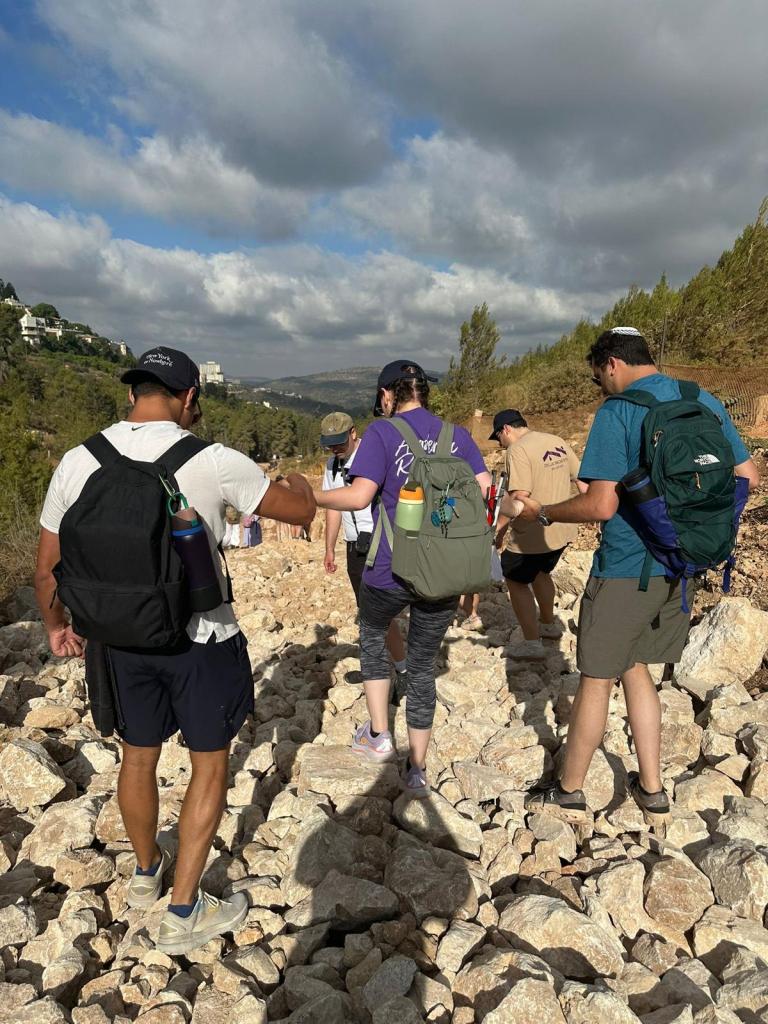
In the midst of this liturgical endeavor, I’ve engaged with those around me in very influential ways. Two of my best friends, beautiful women I’ve met in my program, have been called my “partners in climbs” because of their consistent willingness to be my guides in various situations. I’ve been able to both joke and groan with them about life with limited sight, and it’s been wildly refreshing to not be holding it all in.
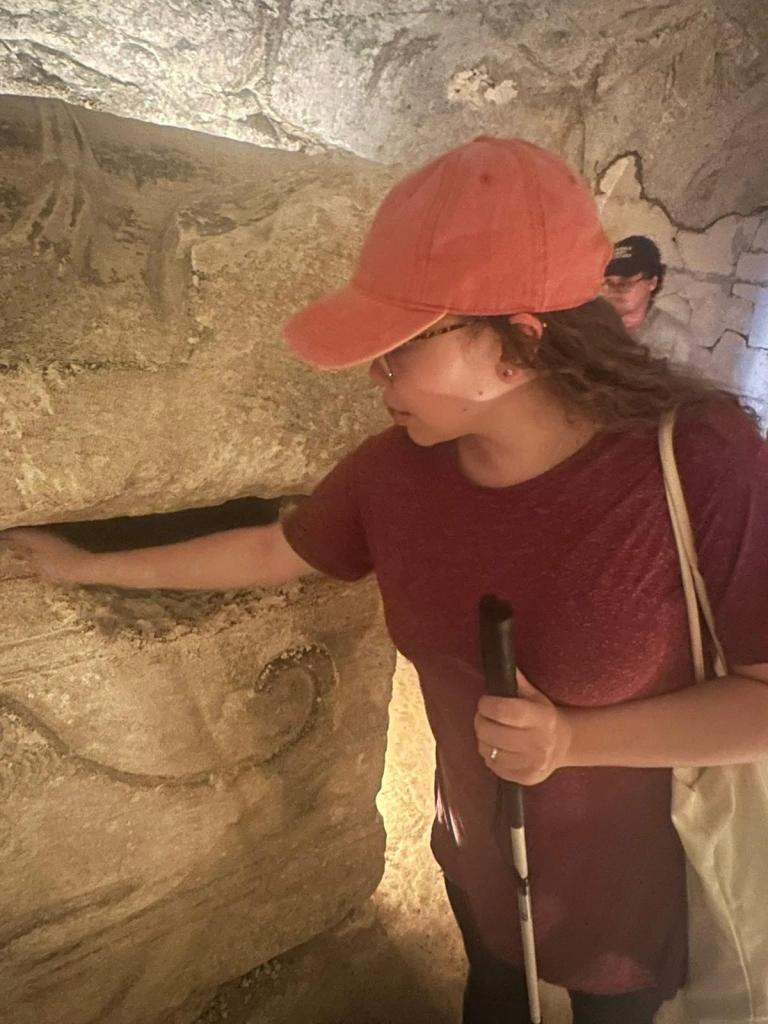
When it came time for me to do my Torah reading for the semester, my gabba’im, two fellow students, laid down their traditional obligations and picked up the scroll, literally, to bring it to my eyes. It may have been the last time I will ever read from a Sefer Torah, and I couldn’t have done it without them. And when we’re out on tiyulim, I’m getting pictures sent to me of the artifacts or views so I can experience them, too. Some of my peers have truly taken on the correct intention of “removing the stumbling block”. (We’ll talk about that one in another post…) It hasn’t been all rainbows adjusting to a new group of people, many of whom haven’t interacted with people with limited sight, but there have been some gems that I am truly thankful for.
And for as many gem experiences I’ve had with my peers, I’ve had just as many with faculty. One of my first Shabbats in Israel included a generously hosted dinner by Kehilat Kol HaNeshama, my Israeli spiritual home. Dinner was accompanied by a lesson from Rabbi Michael Marmur, a moach gadol if I ever did meet one. He played a word game with our group, giving a sheet of paper with a hebrew letter on it to three students. He moved them around to show how the same letters make up different shorashim, and thusly, have different meanings. I couldn’t see the letters. I couldn’t follow this incredible lesson. It was one of those moments where I awkwardly looked down, unsure of what to do.
That’s when another moach gadol stepped forward with her lev gadol. Cantor-Rabbi Shani Ben-Or, my Worship Lab & T’filah professor, quietly walked over, sat down next to me, and started whispering to me what letters were being moved where. There was no big ordeal, there was no interrupting the lesson, there was just simple accommodation. I got to join my peers in soaking up the teachings. The last arrangement of letters was lamed, chet, mem: Lechem, bread. For the life of us, neither I nor Cantor-Rabbi Ben-Or could figure out this word. Then it clicked. Suddenly we were laughing. She, a native Hebrew speaker and dual ordained clergy person, and I, who despite having minimal Hebrew, should know the word lechem, just laughed. It was the moment for me when I felt like more than the student who needed help. Getting to laugh about content as opposed to cracking a self-deprecating blind joke was soulfully edifying. On paper, she was my professor. In reality, she was no more than a stranger to me. But she took the time to assist, and the time to laugh. Human saw human, and it filled my heart a bit more. Little did I know, this was just the beginning of impactful interactions with both Cantor-Rabbi Ben-Or and Rabbi Marmur.
Just a few weeks later, I found myself in Cantor-Rabbi Ben-Or’s office. I was to leyn Torah soon, and there was no guarantee that I’d be able to see the scroll. We had an honest conversation about Halacha, where the movement adheres to it, and what that looks like for me in these moments. We made a plan, and then we made a backup plan. A few days later we met with the gabba’im to practice, and I almost froze. I didn’t want to look at the scroll. My sight had deteriorated since the last time I had leyned. If I didn’t look at the scroll, I wouldn’t have to face the potential reality of no longer being able to see it. I walked past Cantor-Rabbi Ben-Or and whispered “I’m scared”. Her response was simple: “I know, and it’s going to be okay”. For lack of a better term, I just needed to feel seen in that moment. Her acknowledgement reminded me that there was a plan and a backup plan. That week I read from the scroll for my community. Cantor-Rabbi Ben-Or excitedly celebrated with me after the service. More often than not, I put on a brave, collected face when it comes to my sight. Sometimes, having a mentor that knows the significance and the weight, and holds it with you, makes a world of difference. That’s the rabbi I hope to be.
Some weeks later, I was sitting in the back hallway of the classroom building on campus, truthfully trying to hide from everyone, when Rabbi Marmur passed me. My Torah commentary was open on my screen, my font noticeably large.
“How’s Hebrew working with your sight? How is it going?” I flinched. Hebrew and limited sight don’t get along well.
“It’s not,” I replied humorously. He reiterated the question, clearly wanting an honest answer. That’s the thing about Israelis, whether by birth or by aliyah. When they ask a question, even as simple as “how are you?”, they’re asking genuinely. I gave him the real answer. I told him I’m working diligently at it, but it’s the hardest part of my learning. I told him how the first way I learned Hebrew was in braille. I learned Shema, V’Ahavta, and Shehecheyanu in braille before I learned them, or anything else, in print. I told him that’s why I always cover my eyes when I say Shema. My first encounter with those words was tactile so I want every encounter with them to be tactile, too.
“You know that’s in the Talmud, right? I’m pretty sure it was Rabbi Yehuda HaNasi…” I lit up a bit. “I’m pretty sure it was something about the intention of the hand covering the eyes that fulfills the mitzvah. I’ll find it and send it to you.” I excitedly said please, and we parted ways. I was already looking it up when he turned the corner. Berakhot 13b. Yehuda HaNasi. To no surprise, Rabbi Marmur was right. The next day in class, I told him I found it. I don’t know, even to this day, if he realizes just how important his connection was. By pointing me to that text, he also connected me to our tradition in a way that I hadn’t know was possible. I stood at what is believed to be the grave of Yehuda HaNasi shortly thereafter and I said Shema, hand over my eyes.
What is the point in sharing all of these experiences? Well, I will brag about my friends and mentors all day long. But, there is also a connection to Pokeach Ivrim here, too. I was Jewishly raised by a non-dual rabbi and his more traditional wife. Naturally, I fall somewhere in the middle. For now, let’s run with the non-dual understanding of God: the relationships that exist between people. If that is God, then all of these interactions I’ve had with those around me is a literal personification of Pokeach Ivrim. They may not have restored my sight, but my peers and mentors have helped me access, figuratively “see” Judaism, in ways that I didn’t know were within my reach. While I am not exclusively non-dual, I believe there is great meaning in this understanding. Perhaps there is another rewritten blessing in this.
My walk with Pokeach Ivrim has consisted of tanakh, teachers, peers, and pondering. And a little bit of Rashi commentary on the stumbling block. I’ve spent hours in Rabbi Marx’s class learning about our liturgy and how it came to be. It’s been meaningful, and a little fun, to parallel that learning to my experience codifying my own liturgy. It took far longer than five months to establish the liturgy we know today, so I’m confident the path does not end here. Navigating Judaism with limited sight has plenty of challenges, some that hurt not just the eyes, but the soul, too. Now I have something to hold on to, something to uplift my soul, as the future of my eyes remains uncertain.

 Humble Chutzpah