You really can’t make this shiz up…
When I was little, my mom used to pull some reckless driving stunts to get a giggle out of my siblings during car rides (I was the kid terrified in the back seat). When she’d start driving with her knees or doing donuts in the post office parking lot, I’d grab what my family referred to as the “Jesus handle”. As we’d speed up the street or create loops in the lot, I could feel the energy and chaos running through me. In a lot of ways, that’s exactly what today’s sociology class felt like. Except, I wasn’t grabbing for the “Jesus handle” this time. Instead I found myself holding on to every word that a Jewish Rabbi was spewing. Granted, those same words are also what caused the rush of everything under the sun within me…
If you’ve read even one of my posts recently, you know how much I adore my sociology professor. Adore, respect, admire, I could keep going. (No, I’m not saying this hoping she might read this post. I genuinely mean it.) Well, I’m starting to think it’s her entire family that’s amazing. From the very beginning of the semester, she’s been open about her Jewish identity and her role as a rabbi’s wife. I got to meet that rabbi today, and I can honestly say that he and my professor are the epitome of a dynamic duo. Within one minute, and I quite literally mean one minute, my brain just about burst.
I was one of the lucky ones that got to have a more one-on-one conversation with this wise man before class started. I could sit here and talk about my basic question about Tanakh, the events of Mt. Sinai, or the conversation we had about prayer, but in all reality I was so timid during that conversation I don’t really think he got a sense of how deep my religious interests run. In my twenty-one years, I’ve read the Bible (both Old and New Testament), Q’ran, Book of Mormon, a little bit of the Talmud, and a small portion of the (translated) Tripitaka. I find religion fascinating. So when you present me with an individual who quite literally works in religion, who has knowledge out the wazoo about religion, I get excited. Well, I get so excited I almost freeze. But the class conversation… now that’s another story. I’m going to tell you all about that one.
After brief discussion of the sociological perspectives on religion, my professor turned the time over to her husband. Engaging with my peers, he discussed a lot of basic information about Judaism. Then we got to the topic of messiahs. He discussed the complexities of Messianic Judaism, but that’s not what left me speechless. No, it was when he talked about the more generalized theology surrounding a messiah in Judaism. Differing quite significantly from the Christianity I was raised in, Jews don’t believe the Messiah has come yet, but the biblical references to a Messiah are still there in Jewish teachings. After explaining that Judaism doesn’t believe in a “Second Coming”, and that though he wasn’t the Messiah, Jesus was a great teacher, this profoundly intelligent rabbi rattled my brain. Referring to the Messiah, he said, and I quote, “We don’t really know when he, or she, will come.”
DID YOU CATCH THAT?!
With full knowledge that he is a progressive, reform rabbi, I still found myself in shock and hastily writing down this idea before something else came up. The Messiah could be a woman… yeah, I can safely say I never thought about that one. On the tail end of a conversation about the challenging duality of Messianic Judaism, this really captivated my attention entirely. But just as I finished scribbling down “holy crap, messiah as a woman…”, my sociology professor chimed in. If my mind hadn’t been blown enough already, it was about to be in a second. She spoke about how religion is really a mix between self identity and social identity (how we choose to identify versus how society identifies/perceives us). Now what stood out to me here was the idea of religion and self identifying. When you’re raised under a certain religion (for me, Christianity), you don’t really think about self identity. My religious road is long, but more than that, it’s something I’ve kept pretty close to my chest. I don’t often find myself outwardly identifying with any religious affiliation. While I never eliminated this idea for others, I also never considered it for myself. I’ve seen my fair share of kippot, hijabs, crosses, etc. I’ve heard the declarations of faith from both pulpit and peer. I have colleagues who have just finished Ramadan, and participated in self identifying with their religion through the outward expression of fasting. Yet I’ve never been one to think about my own religious self identity. So now you can see how sixty seconds really did completely consume my brain. And in case you don’t believe me:
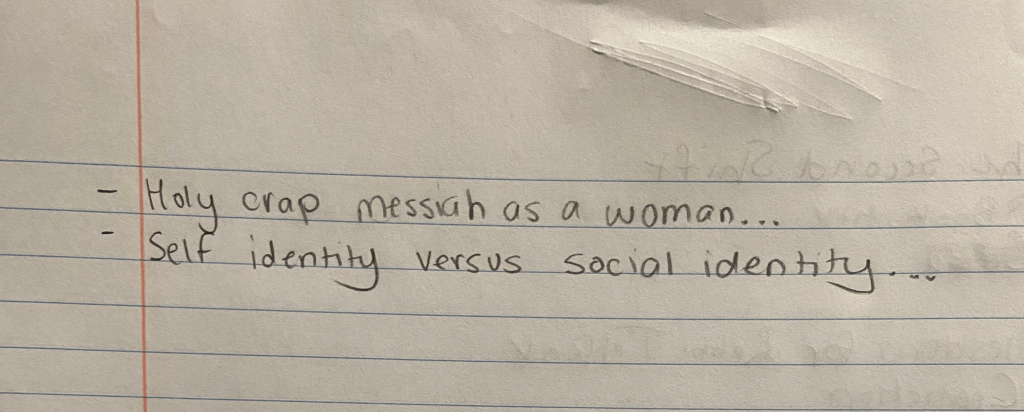
Holy, yes. Crap, couldn’t be farther from it. Within an hour of first meeting a rabbi, my brain was thinking in ways it hadn’t before. This isn’t to say I’m going to jump on a bandwagon of feminists who think the Messiah is a woman, but it is to say that I’m really starting to see the connections between society and religion. Let’s rewind a bit and discuss the sociological perspectives of who I call the OG Three: Marx, Durkheim, and Weber.
In reference to religion, Marx said that it is, “the opiate for the masses”, meaning it makes people complacent. To an extent, it makes them happy, but it more-so makes them “satisfied” with what they have, or complacent in a rather flawed system. Religion wasn’t Marx’s favorite thing, but then again, he was a conflict theorist.
Durkheim, on the other hand, argued that religion gave society structure and roles, that it encouraged appropriate behavior. This isn’t to say there had to be one unanimous religion, but that populations could function sufficiently in part because of their religious lifestyle. Religion doesn’t make people complacent, it helps make society run.
Weber sees religion as a root for societal change. In his text “The Protestant Ethic and the Spirit of Capitalism”, Weber actually uses religion as the foundation for the birth of capitalism. He tied religion to one of the macro structures of society. I have a lot to say about this particular text, but will do so another day.
While I could go on about Weber (I just wrote my thesis about the role of religion in society through early American literature, I literally wrote 25 pages about Weberian religious thoughts), I want to focus on Marx and Durkheim here. I’ll be thinking on both the personal and societal levels. Let’s start with Marx. Religion makes us complacent in (flawed) social structures. Grand example of this? Institutionalized discrimination. At least according to a conflict theorist, religion has made a lot of people complacent in the institutionalized discrimination we’re seeing in places like BYU. Or the recent “Don’t Say Gay” bills being passed. Those that subscribe to these primarily-Christian ideologies are supportive of these movements. It isn’t often that members of those faith communities are the ones opposing such discrimination. So we see it on an educational level. What about a federal? Well, we have some unfortunately great timing on our side. With the recent news that a Supreme Court draft revealed the likelihood of overturning Roe vs. Wade, we can also see this complacency on the federal level. Granted we must also acknowledge that religion makes us complacent in religion. The patriarchal, hierarchical structures of religions can fuel issues like sexism and racism within the very walls of a place of worship. This doesn’t mean every place of worship is inherently flawed, but it does mean that some may add more to their issues than they realize. Religion is itself could be considered a macro structure of society.
We must also look at the smaller side of things. Let’s look at the individual congregant. I’ll talk about myself. Through religion, I became complacent in one set thought process. For a while, I stopped asking hard questions. I felt “satisfied” with the knowledge on doctrine and theology that I had. Granted, that has since changed, but I definitely found myself very comfortable with my voluntary “cap” on thought and knowledge. Perhaps this is why something as “radical” as a female Messiah got me so excited. It’s fascinating to see how my thoughts are progressing as my questions become abundant again in relation to religion.
Though he takes a positive approach to it, I actually think Durkheim and Marx’s thoughts overlap a bit. Marx argues we become complacent, and one of the ways in which we do that is through accepting religious (and consequently societal) roles. This is where Durkheim comes into play. Durkheim believes in social structure, fixed roles, etc. Religion most definitely grants that! Not only do we have the clergy roles in society thanks to religion, we also have a lot of our gender roles. Where a conflict theorist would call this problematic, a functionalist would call it great. With rules (commandments) surrounding work, behavior, and social participation, there are so many ways religion fuels the operation of a society, and our roles therein. I think about places like the Bible Belt, where Sunday church attendance is part of society. Or places like Israel where the sound of a siren prompts two minutes of stillness on Yom HaShoah. Or the Middle East, where the call to prayer can be heard five times a day. Religion is so vastly integrated into those societies that it inherently influences daily (or holiday) operations. Durkheim has some weight to his argument.
Just like I did with Marx, how do/did I relate to this? That’s harder to answer. My religious affiliation, whether past or present, has guided my behavior, yes, but I don’t know that it’s been in the most significant ways. I haven’t committed a crime, but that because of more than just my religious beliefs. I observe the Sabbath as best I can, which I suppose does contribute to macro structures like the workforce (plot twist: residence halls don’t observe the Sabbath. Crazy crap happens regardless of the day of the week). I think where things become grey for me is in regard to my future. I would love to have the opportunity to stay home and raise kids. To some, that’s a religiously-based gender role. But that’s not my reasoning behind this desire. So I’m hesitant to say I fit nicely into Durkheim’s model, though I’m sure with a little more thought, I’d get there. I think Durkheim’s perspective is where we see a lot more regarding self-identity too. Part of religion’s role in society is acknowledging religion. For personal reasons, I’ve always kept my beliefs very near to me and not as public. Perhaps this was in fear of judgement, perhaps it was because for a long time I didn’t know what I believe. That’s not necessarily relevant here. What is relevant, is that maybe this lack of self identifying is what made discovering my personal religion-based societal roles difficult. More food for thought on my end.
In a seventy-five minute class period, I only needed sixty seconds to be shaken to my core. This post isn’t about changing my religious ideology. In fact, my beliefs when I left class were essentially the same as when I arrived. I would be writing the same post if I had been shocked by an Imam, priest, or monk. This isn’t about what religion I fall under, it’s about making these big-world-connections. My professor and her husband really tag-teamed this religious shock process (again, dynamic duo…) and despite having written this post, I still have more thoughts. I still have a lot of questions. I feel like they never end, and I hope they never do. I want to keep writing about religion, so don’t be surprised if this isn’t the last post about it. However, I should probably be productive and finish the essay that is due tomorrow.
To finish this post sparked by a rabbi, I leave you with a transliteration and translation of an awesome Hebrew saying: Eizehu chacham? Ha’lomed mi’kol Adam. Who is wise? He who learns from all people. May we all one day be wise!
 Humble Chutzpah